
Wolfgang Loch GmbH & Co. KG is a family-run automotive supplier with around 400 employees and three plants, characterized by highly complex manufacturing processes and strict automotive certifications. Binders, printed shift plans and paper-based maintenance plans cost time and made complete audit evidence difficult. With Operations1, Loch made the leap to a fully digital value chain: 98% paperless in selected areas, 33% higher setup efficiency and 9 percentage points more OEE.
Key Takeaways
Wolfgang Loch GmbH & Co. KG, automotive supplier (stamped, drawn and formed parts, welded assemblies)
Digital process, setup and maintenance instructions along the entire value chain, from goods receipt to shipping
98% paperless in the fully converted areas
33% higher setup efficiency thanks to standardized work instructions
9 percentage point increase in OEE thanks to better equipment availability
The Starting Point
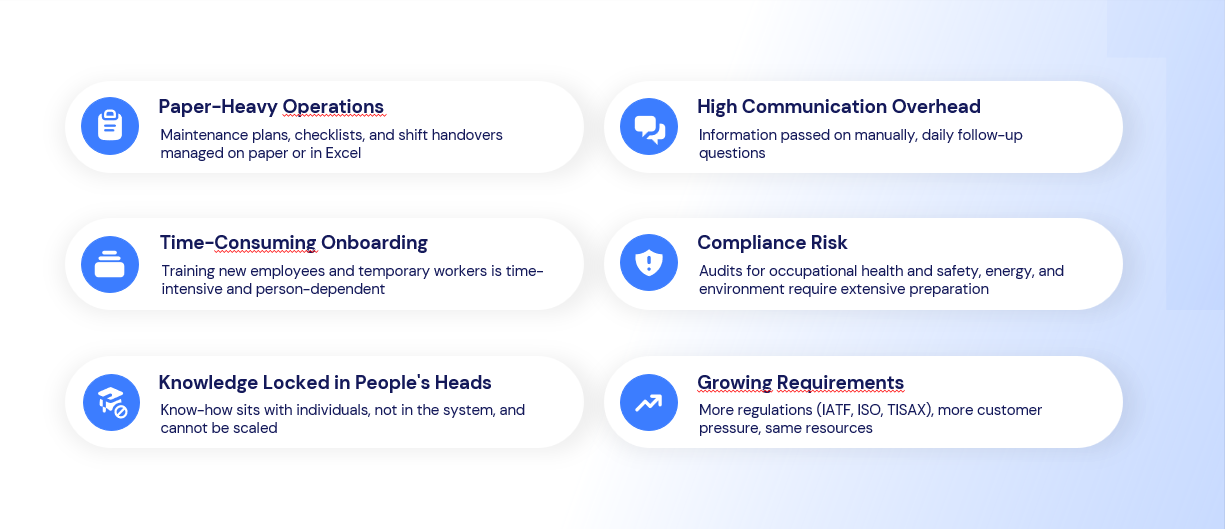
Like many mid-sized manufacturers, Loch came from a paper-based world. Binders hung at every machine, shift plans were printed up to three times a day, and maintenance plans existed only on paper. At the start of each shift, employees needed at least 15 minutes to gather the right information. Whether the binder was up to date remained uncertain.
"In some areas, we filled out more paper lists and slips than we actually spent working productively. And that doesn't even include scanning, renaming and archiving," says Torben Zerfaß, Process Technician at Wolfgang Loch GmbH & Co. KG.
Knowledge was stored in the heads of individual employees. New colleagues required extensive training because paper alone could not convey the processes. At the same time, compliance requirements in the automotive sector kept rising, and customer audits demanded complete, traceable evidence. "In a paper-based world, doing this without errors is simply not possible," says Andreas Baier, responsible for integrated management systems, lean management and business processes at Loch.
Management set the direction. Owner and Managing Director Marius Loch sums it up: "Anyone who merely manages the status quo instead of digitizing and optimizing processes will not survive in the medium term."
The Path to the Solution
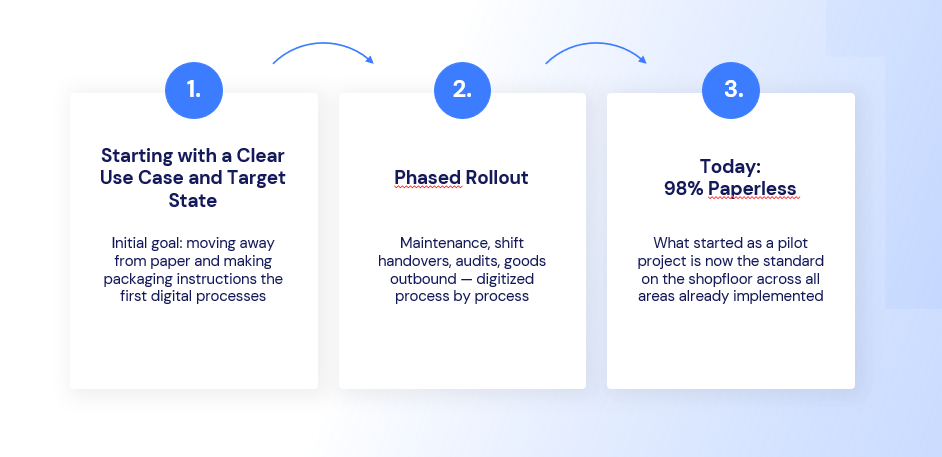
The impetus came from the shopfloor: an area manager wanted to digitize the packaging instructions. Each product had its own binder that employees first had to find and then interpret. The first idea was to put Excel documents on screens as PDFs. But a half-digital solution would not have solved the actual problems. That is how Loch came to Operations1 and chose a complete platform solution.
Loch has been using Operations1 since 2021. After a slower start, partly due to the after-effects of COVID, the team defined pilot areas, first implemented smaller topics there, expanded the pilots and then scaled. What began with packaging instructions developed into company-wide digitization over three to four years. Today, Loch uses Operations1 in almost every process step:
Goods receipt: Visualization of incoming goods
Stamping: Process and setup instructions, tool maintenance, machine and equipment maintenance
Degreasing/surface treatment: Process instructions, machine and equipment maintenance
Assembly: Process and setup instructions, machine and equipment maintenance
Packaging and shipping: Packaging and shipping instructions, load securing
Support processes: Audits, shift logs, inspection rounds (occupational safety, environment, energy, lean, 6S)
Particularly noteworthy: when new stamping tools are designed, an operating manual for later maintenance is created in Operations1 at the same time. From the very first use, maintenance knows what the designer had in mind and which adjustments to make when problems arise.
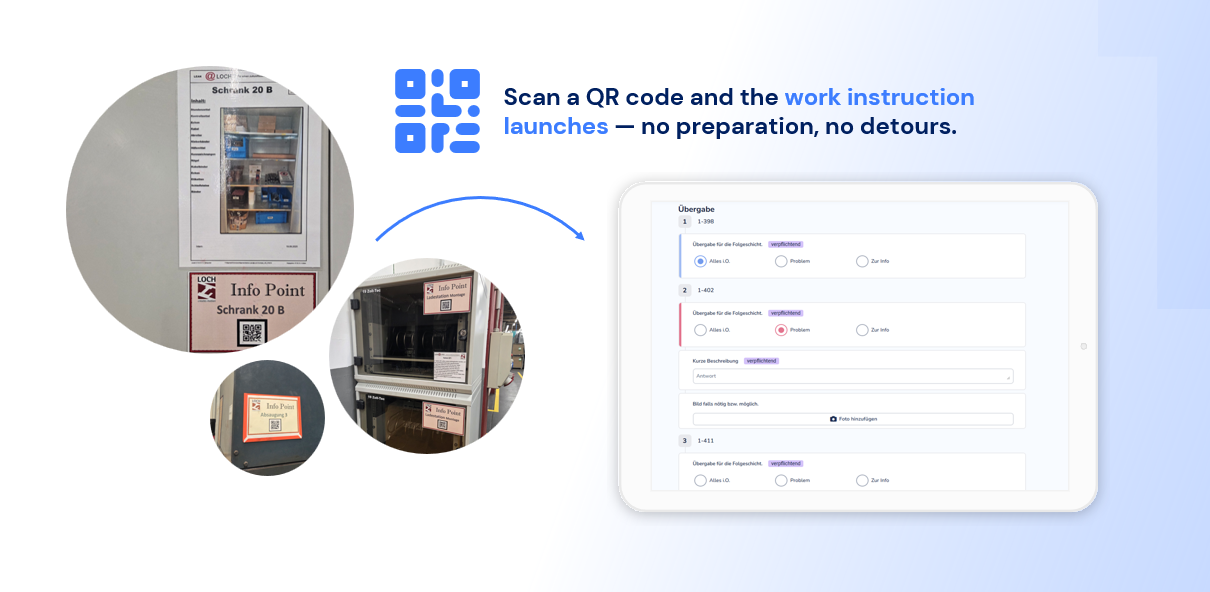
Today, every machine has a QR code. Employees arrive for their shift, pick up a tablet, check production planning via the shift log, scan the QR code at their workstation and are taken straight to the right process instruction. What used to mean 15 minutes of searching now takes two minutes.
A concrete example shows the cultural shift: an employee noticed that a step in a process instruction was not documented properly. Using the camera app, he photographed the problem and triggered a task at 9:12 a.m. By 11:02 a.m., the instruction had been updated and the change documented. The worker on the next shift automatically received a change notification and actively confirmed it. In the paper-based world, this would have taken days.
The employees who had previously created paper documents also took over the digital implementation. No additional staff was needed. Together with key users from each area, Loch defined uniform templates. This created a common thread: a process instruction looks the same everywhere, whether in stamping, assembly or laser processing. Christopher Nüßlein, Senior Customer Success Manager at Operations1, supports Loch as its central point of contact. The steps Loch took (a clear target vision, a small pilot area, quick wins, early involvement of employees, strong key users, uniform templates) now serve Operations1 as a blueprint for onboarding new customers.
The Results
Digitizing the entire value chain has had a measurable impact at Loch:
98% paperless in the fully converted areas.
33% higher setup efficiency thanks to standardized work instructions that make setup knowledge available independently of individual people.
9 percentage point increase in OEE thanks to better equipment availability and faster access to maintenance information.
40 to 50% time savings in administration: no searching, no paper handling, no manual archiving.
100% digital documentation: audit evidence is available at the push of a button.
From 15 to 2 minutes: the time employees need at the start of a shift to reach the right process instruction.
The change goes beyond the numbers. Employees actively take responsibility for process quality: they report improvement opportunities directly via Operations1 and document the steps of new processes during the very first run.
"Efficiency begins where uncertainty ends. Digital instructions reduce questions to a minimum and leave room for what matters: the quality of our work," says Dennis Bender, Head of Prototype Construction & Small Series Production.
The transformation is also recognized externally. During an OEM customer audit, the auditor described Loch's digital documentation as a "benchmark."
Outlook
Loch does not see digitization with Operations1 as a completed project but as the core of its digitization strategy. The next steps:
a dashboard for all workers across all three plants
integration with ERP and MES systems for end-to-end data processes
expanding automation
using the AI assistant for context-based problem solving directly on the shopfloor
About Wolfgang Loch GmbH & Co. KG
Wolfgang Loch GmbH & Co. KG is a second-generation, family-run automotive supplier headquartered in Idar-Oberstein, Germany.
Founded: 1976
Employees: around 400
Locations: three plants (prototypes, pre-series, main production)
Core business: stamped, drawn and formed parts as well as welded assemblies
Market position: Tier 1 and Tier 2 supplier
Certifications: ISO 9001, IATF 16949, ISO 14001, ISO 50001, TISAX, ASM
Production is highly complex: presses of up to 1,000 tonnes, welding systems, laser technology and various joining processes create a wide variety of processes. At the same time, the extensive certifications place high demands on documentation. Every process step must be complete, up to date and verifiable at any time.