
Zünd builds around 1,000 digital cutting systems per year in Altstätten, Switzerland, and because customers configure their system from a modular kit, hardly any two machines are alike. This variant diversity could no longer be managed with Excel lists, PDF instructions and paper binders. With Operations1, Zünd has digitalized its entire assembly process end to end, from the ERP order to the customer protocol, increasing delivery quality by 10 percentage points while eliminating around 30 minutes of documentation effort per customer system.
Key Takeaways
Zünd Systemtechnik AG, mechanical engineering (modular digital cutting systems)
Digital assembly instructions and inspection protocols with ERP integration (Sage b7), from goods receipt to shipping preparation
+10 percentage points in delivery quality through mandatory checkpoints in assembly
Around 30 minutes saved per customer documentation through automatic report generation
50 minutes saved per week on searching for and tracing assembly steps
The Starting Point
Zünd does not manufacture components itself; it assembles. More than 80 percent of its suppliers are located within 35 kilometers, subassemblies arrive order by order and pass through four steps: goods receipt, basic installation, final assembly and shipping preparation. Precision and proof matter at every stage. Side parts must be bolted at right angles within tight tolerances, and the vacuum table, beam and control unit involve numerous measuring points for electrical safety, positioning accuracy and vibration behavior.
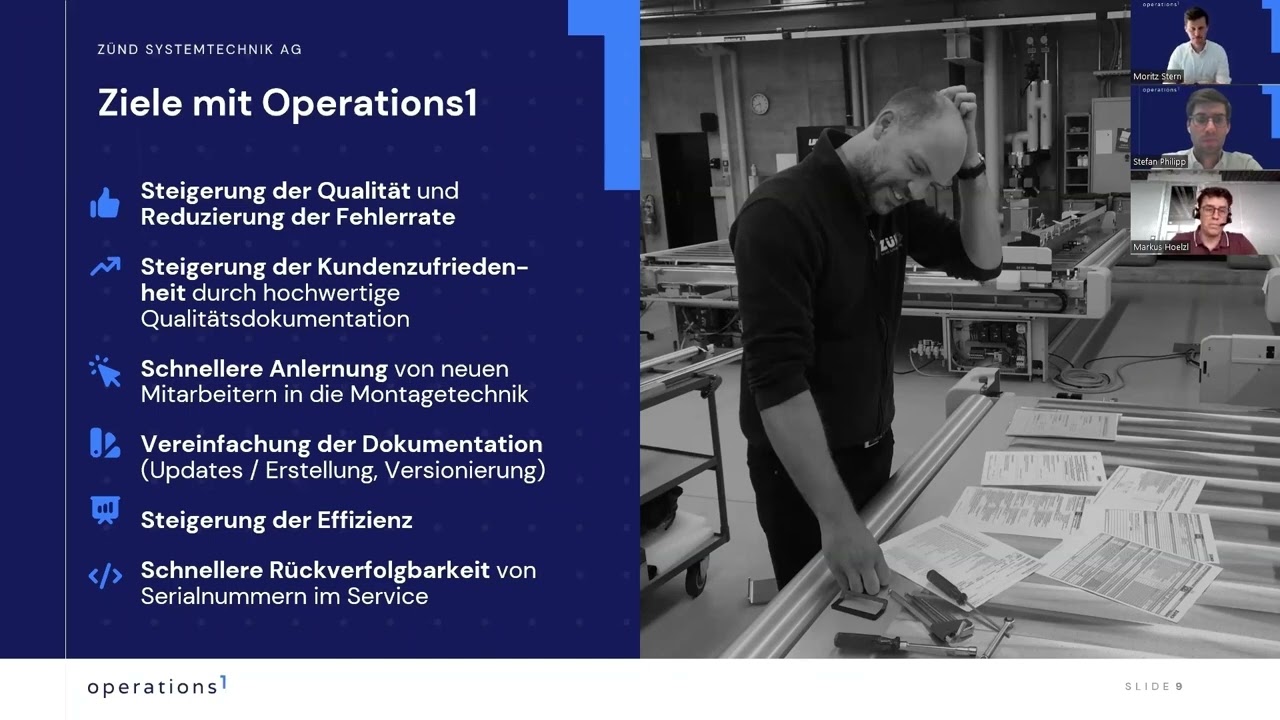
All four steps were paper-based. The ERP system Sage b7 delivered an order-specific bill of materials, but the fitter had to work out which steps applied to the specific machine: cross out everything irrelevant from a long, small-print list, then follow the instructions in a PDF on an open laptop. "We are highly dependent on employee knowledge," says CEO Markus Hölzl, describing the situation at the time.
The consequences showed up in several places.
Individual process steps were skipped or shortened, and service technicians later had to fix the resulting issues at the customer's site. Fitters noted serial numbers and measured values on slips of paper and then typed them manually into the ERP to issue warranty certificates, with the risk of typing errors. At the same time, customer requirements for documentation kept rising, for example regarding flatness, vacuum density and knife positioning accuracy. This data was compiled manually for every machine.
Document management added to the burden. Each of the nearly 50 assembly technicians had a binder with instructions for the series models. Every change meant copying, punching, distributing and filing 50 times, and anyone on vacation received the update late or not at all. Protocols ended up in binders that had to be kept for the roughly 20-year lifespan of the machines and searched laboriously for service questions. And in a growing company that struggles to find skilled workers with specialized abilities, onboarding new fitters took too long.
"Excel is certainly good and useful software, but it is not really suitable for digitalizing the shopfloor. The variant diversity and increasing complexity of our systems could no longer be handled in a paper-based process," says Markus Hölzl.
Stefan from Operations1 puts this into perspective: the team sees exactly these kinds of lists at many manufacturers. A printed bill of materials from the ERP, and the responsibility for what needs to be done rests with the worker. That makes Zünd's experience relevant for almost any machine and plant builder with high variant diversity.
The Path to the Solution
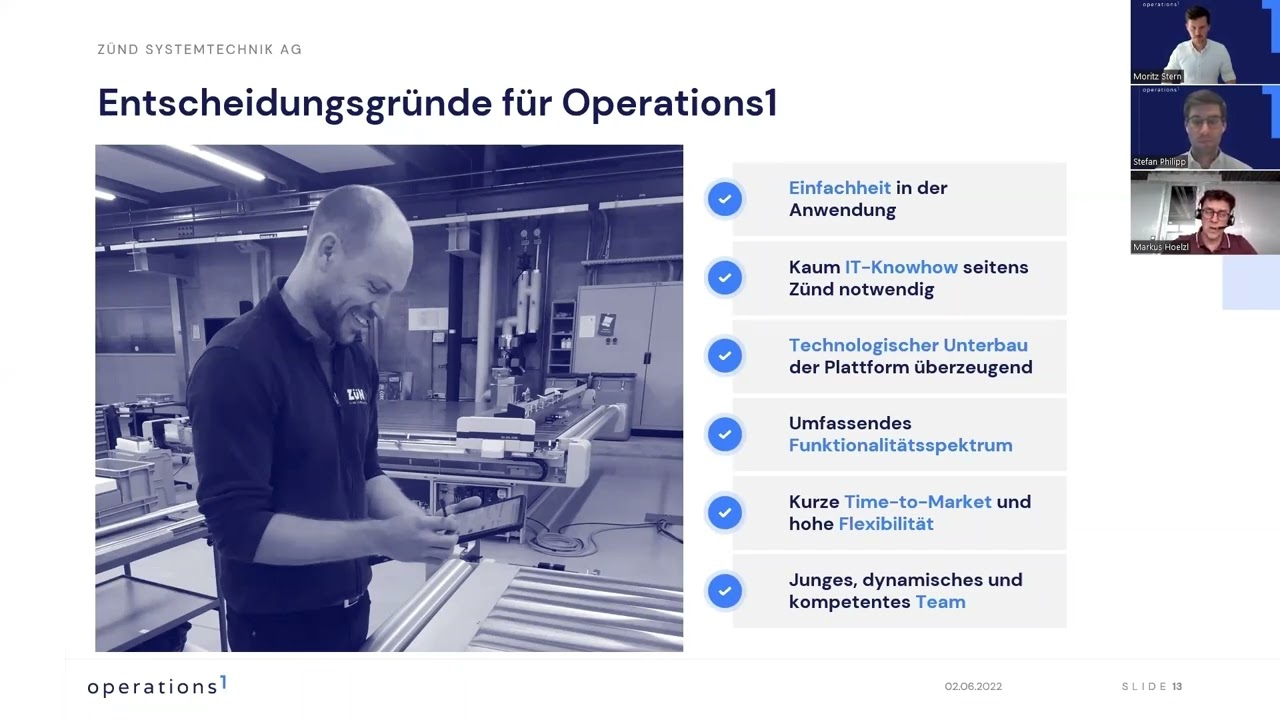
Zünd aims to digitalize the company wherever possible and to rethink entire processes rather than simply replace paper. Initiated by Michael Zahnd, the company chose Operations1 after a vendor comparison: for its intuitive operation with hardly any training required, its cloud architecture that relieves limited IT resources, and its REST API for bidirectional data exchange with the ERP. The team was also a deciding factor. "In the preparatory talks, the team very quickly produced a convincing as-is analysis of our situation and found exactly the right answers to our challenges," says Markus Hölzl.
After an on-site as-is analysis and a jointly developed target process, Zünd first uploaded its existing PDFs to become productive quickly, then gradually converted them into interactive instructions with videos, images and interactions. In parallel, the interface to Sage b7 was built. "It really was backbreaking work because we had to map the different variants correctly, but it was worth it," says Jürg Oggenfuss, Team Leader Quality Assurance. Results were visible after just under six months, and the interfaces have run reliably and unchanged ever since.
The new process is fully digital: from the bill of materials in Sage b7, Operations1 automatically builds a variant-specific order containing only the instructions and inspections relevant to that machine. The fitter confirms mandatory checkpoints, records measured values with tolerance checks and scans serial numbers instead of typing them. The completed report goes back to the ERP automatically and to the customer as a protocol.
The Results
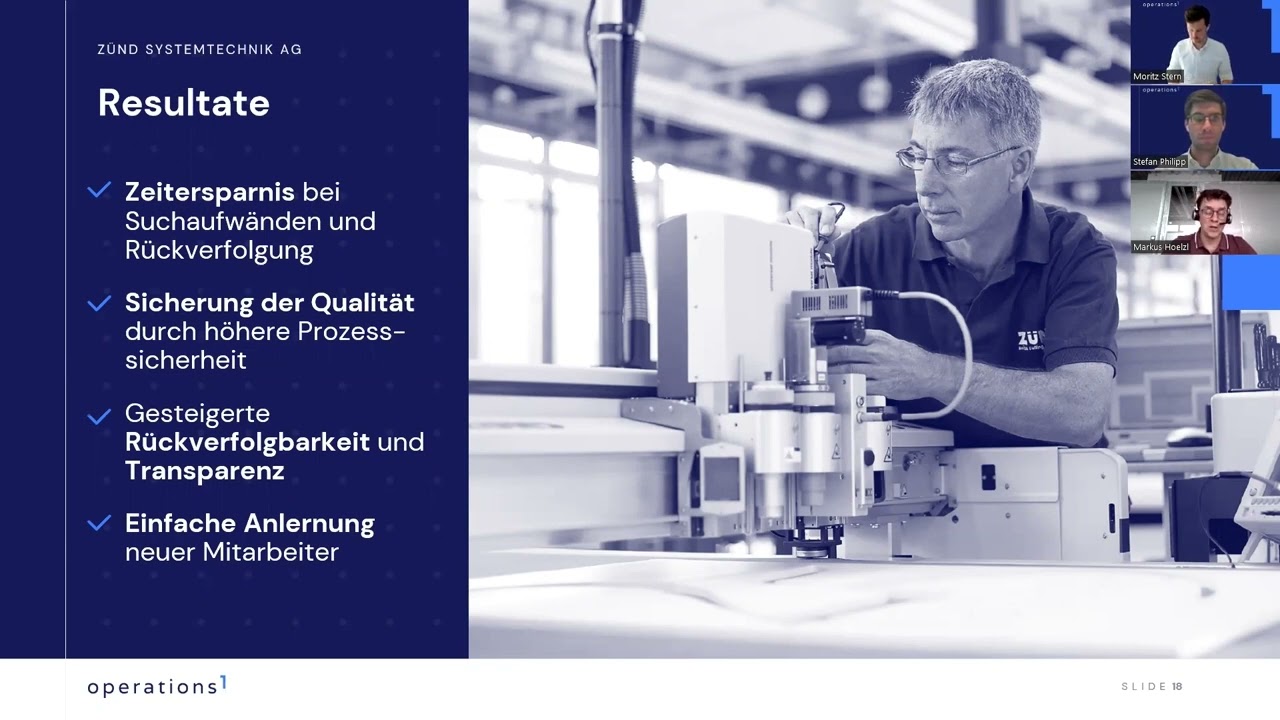
+10 percentage points in delivery quality: Mandatory checkpoints in digital assembly and inspection instructions raise the delivery quality of Zünd systems by 10 percentage points.
30 minutes less per customer documentation: For standard requirements, documentation is generated automatically from the process instead of being prepared manually in around half an hour per machine.
50 minutes per week on searching: Assembly steps can be found digitally, saving 50 minutes per week on searching and tracing.
Error-free serial numbers: Scanning replaces around 25 minutes of manual typing per machine.
Traceability is at least as valuable: for every machine, Zünd now knows which version of the assembly instructions it was built with. For machines that run for around 20 years, that is a clear advantage for service. Acceptance was convincing too. "After a short introduction, employees, including the initial skeptics, recognized the benefits for themselves and now use the solution intensively," says Michael Zahnd, initiator of the software introduction. Today, more than a third of the employees at the Altstätten site work with Operations1 every day.
Outlook
The positive response in assembly is driving expansion into other areas. Zünd is currently rolling out Operations1 in incoming goods inspection, material monitoring and first article inspection. The company is also considering mapping maintenance processes on the platform.
About Zünd
Zünd Systemtechnik AG is an independent Swiss family business, founded in 1984 and now managed by the second generation at its site in Altstätten. With more than 500 employees worldwide and 13 subsidiaries, Zünd develops and manufactures modular digital cutting systems for a wide range of materials. Around 1,000 cutters per year go to customers in eight industries, including graphics, packaging, leather, textiles, upholstery and furniture, and composites. The systems are designed for a lifespan of around 20 years. Production is pure assembly with high variant diversity: customers configure their system from a broad module portfolio, complemented by custom builds.