
Within their markets, the Schunk Group is one of the Hidden Champions. The company builds high-tech systems ranging from ultrasonic welding systems to environmental simulation systems, and it also manufactures materials products made of graphite, silicon carbide and industrial ceramics. This breadth makes manufacturing exceptionally heterogeneous, and that is exactly where the challenge lay: paper lists, binders and established routines were to be replaced by digital, standardized processes that ensure the same quality at every site. Today, the daily inspection of a gas storage area takes only half as long, standardized setup instructions reduce setup time and scrap, and the start in two business units has become self-sustaining: the departments now come forward on their own and ask about Operations1.
Key Takeaways
Company: Schunk Group, technology group (mechanical and plant engineering as well as materials technology)
Use case: Paperless manufacturing with digital checklists in maintenance, setup and TPM
Result 1: Daily inspection of the gas storage area at the Heuchelheim site halved from 30 to 15 minutes, saving around 30 hours per month across all reports of central maintenance
Result 2: Setup time reduced by 10 minutes per setup process
Result 3: From launch in two business units to use across multiple business units and sites, driven by demand from employees themselves
The Starting Point
Companies that combine mechanical engineering and materials technology under one roof know the problem: assembly processes, batch manufacturing and continuous manufacturing each follow their own rules. At Schunk, many of these processes ran on paper and depended heavily on the knowledge of individual employees.
In maintenance of the gas and compressed air supply at the Heuchelheim site, this mainly meant effort. "We used to deal with a lot of paper and swapping binders. We invested a lot of time," says a maintenance employee, describing the old routine. The checklists were more than internal documentation. Some had to be forwarded to the Regierungspräsidium (regional government authority) or other organizations to prove that the systems were in proper condition. "Because if our systems don't run properly, we end up with production downtime."
At setup, there was simply no standard. "We had no structure. Everyone just did what they had always been shown, because it had always been done that way," recalls an employee from manufacturing. And for the weekly Total Productive Maintenance on the presses, a DIN A4 sheet hung on the machine, supplemented by adhesive dots for the individual stations. Inexperienced colleagues had to search for information, and supervisors had to walk past every machine to check whether maintenance had actually been carried out.
For management, this raised a strategic question. "We are known in the market for consistently high quality, and we must ensure that Schunk delivers the same consistent quality everywhere in the world," says Dr. Alireza Tavakoli, Managing Director Digital Industries at the Schunk Group. With 64 sites in 26 countries, it is hard to keep this promise with paper and tacit knowledge.
The Path to the Solution
Schunk approached digitalization with a stocktake. In 2022, the company collected digital production use cases across the group. What one business unit called a "worker guidance system," another called an "assistance system." These use cases were clustered, and the team then examined which software solutions could cover them. After comparing several vendors, Schunk chose Operations1 because of its performance and range of functions.
The rollout deliberately started small: in two business units and plants, with multipliers who were keen to implement the first use cases. Dr. Tavakoli sums up the core of this approach: "Operations1 was a good quick win for us. On the one hand, we had a solution with which we could quickly show good, tangible results, and at the same time we could embed it in our entire IT architecture."
At the Heuchelheim site, this is what it looks like in practice:
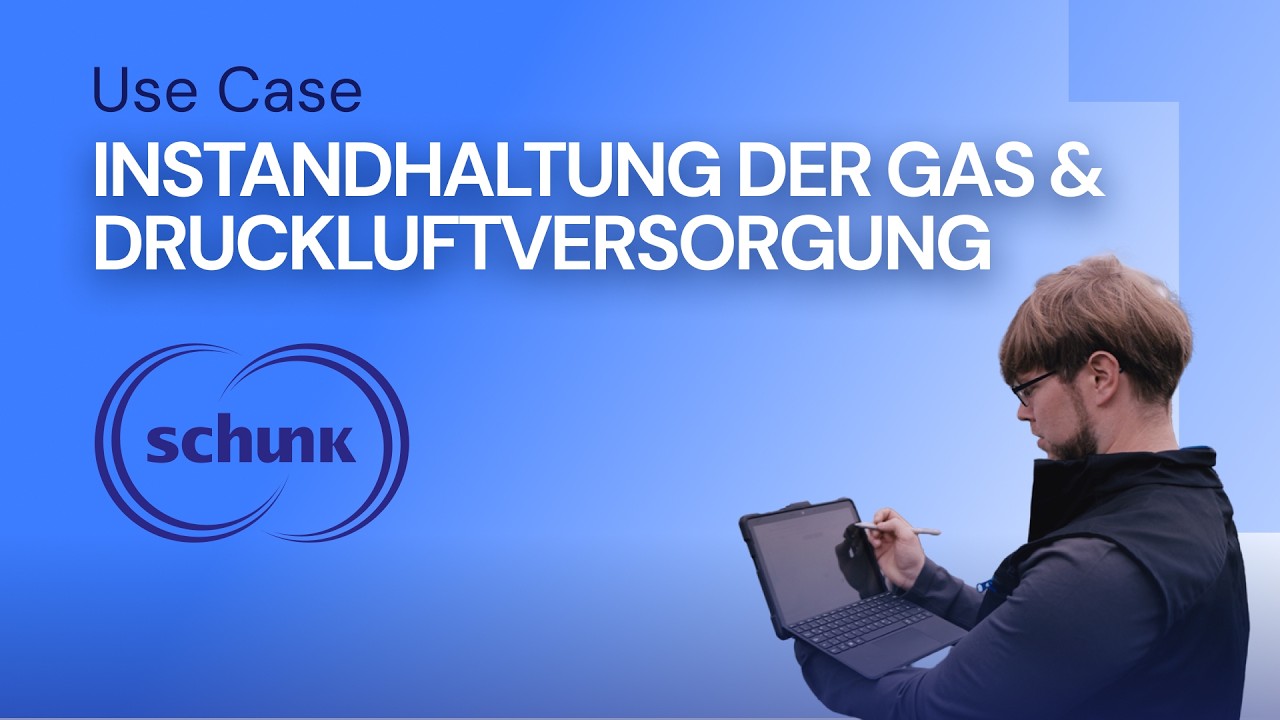
Maintenance of the gas and compressed air supply
Daily inspections now run as digital checklists in Operations1. QR codes on the systems lead directly to the correct list, so there is no more searching for documents. If a fault is found, employees then initiate repair and spare parts procurement.
"The report is started, the report is completed, it is labeled correctly right away with the appropriate number, and simply filed." Anyone who needs access receives a link or a PDF. Because all reports are stored centrally and can be found through filters and search, Schunk can provide full transparency at any time, including to authorities such as the Regierungspräsidium.
Setup in manufacturing
Every setup follows a digital step-by-step guide with photos and videos. "You open your Operations1, click on it, start the report and can tick off everything you've done step by step." If problems arise, the team adds images or videos to the instructions afterward so that everyone benefits.
TPM at the press
In the metal center, the weekly TPM plan first shows employees which machine they are standing in front of. Conditional steps adapt the plan: if the press ran this week, additional checkpoints appear; if it stood still, some of them are skipped. Oil levels, screw connections and pressures are checked with sample images, and the target condition is immediately visible.
The fundamental difference from the old A4 sheet is that the instructions no longer just say what to check. They clearly describe how to do it. To finish, the employee confirms with their personnel number, and the next maintenance task is automatically due one week later.
The Results
Gas storage inspection halved from 30 to 15 minutes: The two gas storage areas at the Heuchelheim site are inspected daily. With Operations1, each inspection saves 15 minutes. At ten inspections per week, this alone amounts to around 10 hours per month at this site.
Around 30 hours saved per month in central maintenance: Across the roughly 350 reports that central maintenance in Heuchelheim produces each month, each report saves about 5 minutes through less documentation effort and faster provision of work materials. The trend is rising.
10 minutes shorter setup time per setup process: Standardized digital setup instructions on mobile devices shorten walking distances and make setups process-reliable. Schunk confirmed this in its own setup analysis with a workshop.
The numbers only explain part of the success, though. The decisive effect showed in the demand from within the organization. "What really strengthened my decision to use Operations1 is that people came to me and asked, 'Could we do that too?'" says Gerhard Wulz, VP Operations, BU Industry. "Until then, we wanted this to happen. Now the employees are coming to us."
This snowball effect carried Operations1 beyond the two pilot business units. Today, the platform is in use across several business units and sites, in assembly in mechanical engineering as well as in batch and continuous manufacturing in materials technology. One use case has become many: maintenance, quality, OPEX, setup technicians and assembly all use the platform, from checklists to changeover processes to the introduction of new products and assembly lines.
In day-to-day work, the biggest change is independence. Training for setup itself does not get shorter; new employees are still supported for one to two weeks. However, the many new documents make onboarding better in terms of content, and afterward new colleagues work through orders more independently, with far fewer questions for experienced colleagues.
For TPM, the greatest value for Schunk currently lies not in measurable time savings but in fully digital documentation and central transparency. "This way I have everything on one screen and can look straight into it," instead of walking to each machine individually. For Dr. Tavakoli, digitalization also strengthens employer attractiveness, because new employees increasingly expect digital tools instead of paper forms.
And the original goal of consistent quality at all sites is within reach: "Transferring this know-how is relatively easy with Operations1, because it is a visual language. It guides employees, and that enables us to deliver the same quality worldwide."
About the Schunk Group
The Schunk Group is a foundation-owned technology group headquartered in Heuchelheim near Gießen, founded in 1913 by Ludwig Schunk. The company operates in two fields: mechanical and plant engineering, including ultrasonic welding, laser, climate and environmental simulation systems, and materials technology, with products made of graphite, silicon carbide and industrial ceramics produced by 3D printing. Customers include companies in the semiconductor, rail and aerospace industries. With over 10,000 employees at 64 sites in 26 countries, Schunk generated revenue of €1.8 billion in 2025. Manufacturing combines assembly processes with batch and continuous manufacturing, some of it for export-controlled dual-use products.