
In around ten years, Quantum Systems has grown from a start-up with four founders into a leading manufacturer of vertical take-off drones, with more than 700 employees and production sites in several countries. When demand surged, paper-based processes and the tacit knowledge of the first employees quickly reached their limits. With paperless manufacturing based on Operations1, Quantum Systems has increased its output by 300% within twelve months, reduced its error rate from over 50% to under 2%, and ramped up new sites worldwide with consistent standards.
Key Takeaways
Quantum-Systems GmbH, aerospace (unmanned aircraft systems, eVTOL drones)
Paperless manufacturing with digital work instructions, serial number tracking and a global rollout
+300% output within 12 months
Internal error rate reduced from over 50% to under 2%
Training time for new employees cut from 1.5 months to 2 weeks (−70%)
The Starting Point
For manufacturers, rapid growth is both an opportunity and a risk. At Quantum Systems, this was especially clear: with a high order volume, driven in part by strong demand for the Vector drone, production had to deliver many times more in a short period. At the same time, the products are highly complex. Because the drones are designed to be light and compact, assembly depends on the exact placement of every cable and component.
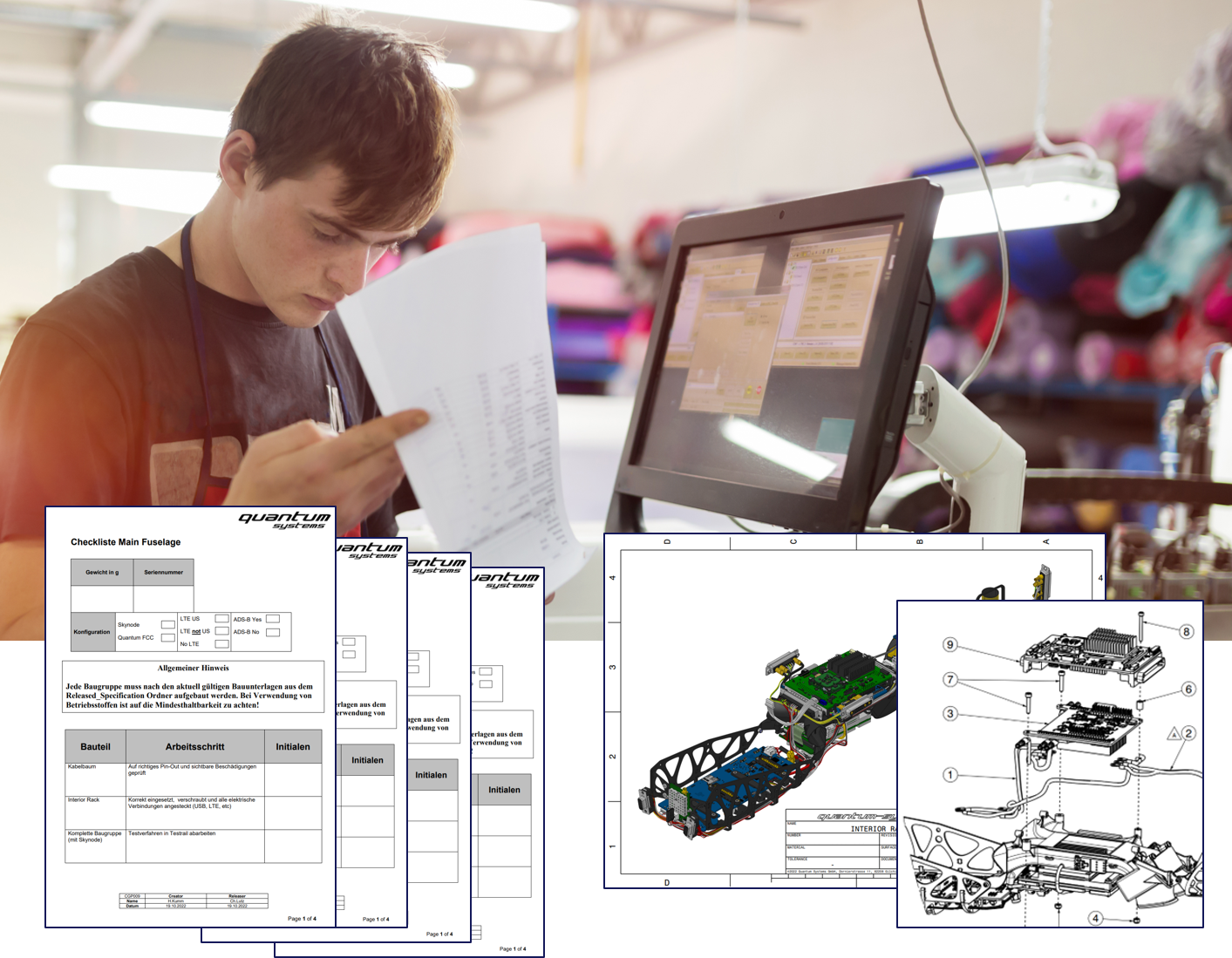
Production was based almost entirely on the experience of the employees who had been there from the start. There was hardly any documentation, and what existed was on paper. New colleagues learned through a buddy system. The existing drawings, mostly PDF exploded views, were not sufficient and were not always up to date on the shopfloor. "The employees couldn't see exactly whether the cable goes in front of the clip or behind it," recalls Andrea Schugmann, Production Engineer at Quantum Systems.
It took around one and a half months for a new employee to be fully trained. Inspection routines and checklists were kept manually on paper, then scanned and filed. Checklists went missing, and components that were replaced later led to mix-ups. Even the serial numbers of flight-critical components, which Quantum Systems must be able to trace in full under the aerospace standard EN 9100, were scanned with a phone, copied onto paper, scanned again and filed.
"It was well documented, but it was hard to find anything. And with the growth ahead of us, it simply wasn't manageable anymore," says Andrea Schugmann.
This situation is typical of many companies, including established mid-sized manufacturers: tacit knowledge sits in just a few heads. Whether the trigger is a ramp-up or demographic change, the problem is the same. Anyone who wants to scale must first make this knowledge available.
The Path to the Solution
To enable the rapid global ramp-up of new sites, Quantum Systems set clear goals: digitalizing production-related steps to achieve paperless manufacturing, building scalable knowledge transfer and ensuring consistent quality through standardization and greater process reliability, even as output increased.
Start Small, with the Most Complex Case
The foundation was a value stream analysis of production. To get started, the team deliberately chose one of the most complex systems, the interior rack, to test whether even this assembly could be mapped in Operations1. During an eight-week onboarding, Andrea Schugmann worked closely with Christopher Nüsslein, Customer Success Manager at Operations1: gathering ideas, designing the implementation and trying it out. Their shared guiding principle: the new solution must not create extra work for the operators, it should make their work easier.
Drawing on his experience from many implementation projects, Christopher Nüsslein names four success factors that also applied at Quantum Systems: a clear goal, an iterative approach focused on one use case instead of a big-bang rollout, involving users early through pilot groups and feedback loops, and active buy-in from top management.
From Tacit Knowledge to Digital Work Instructions
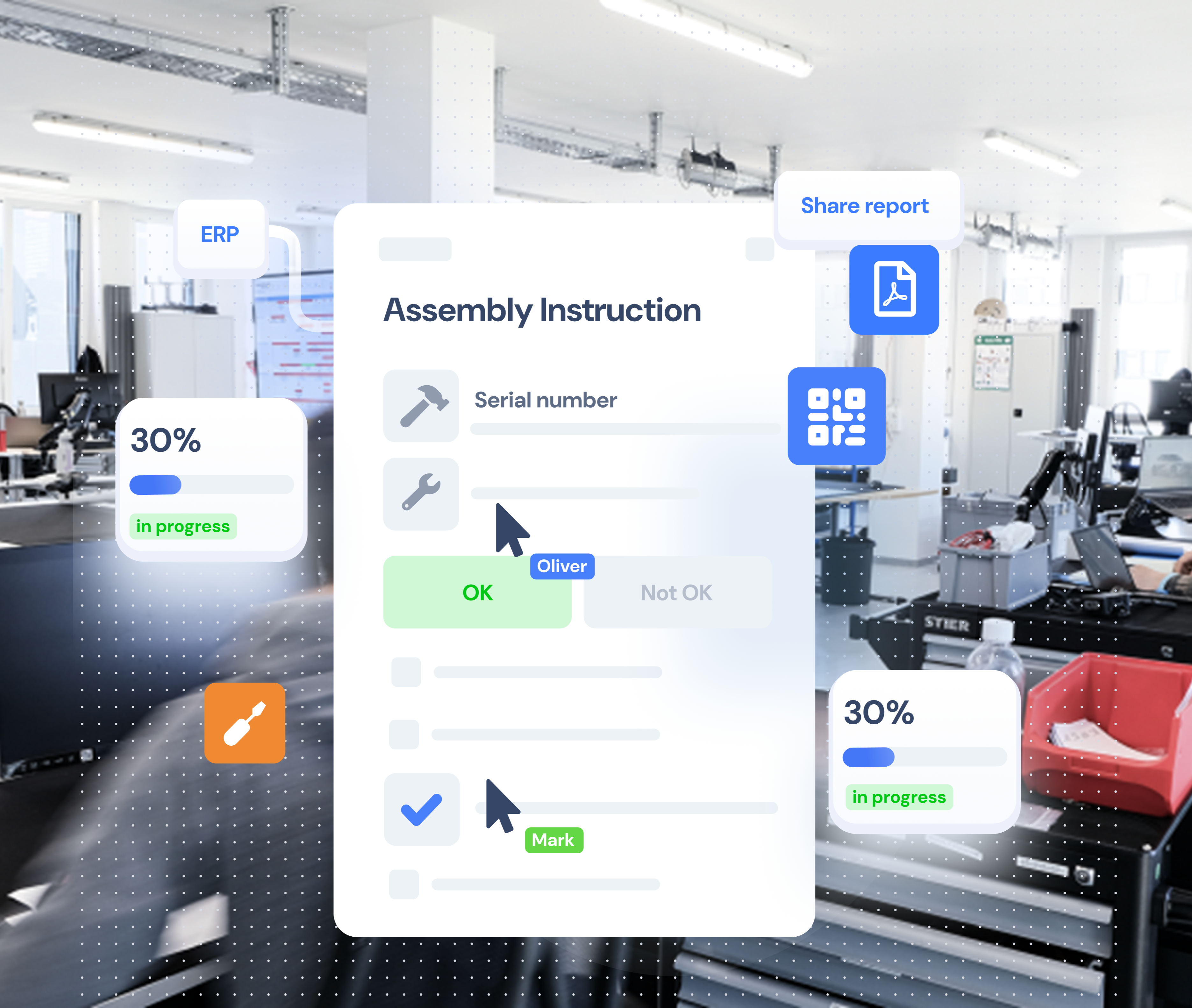
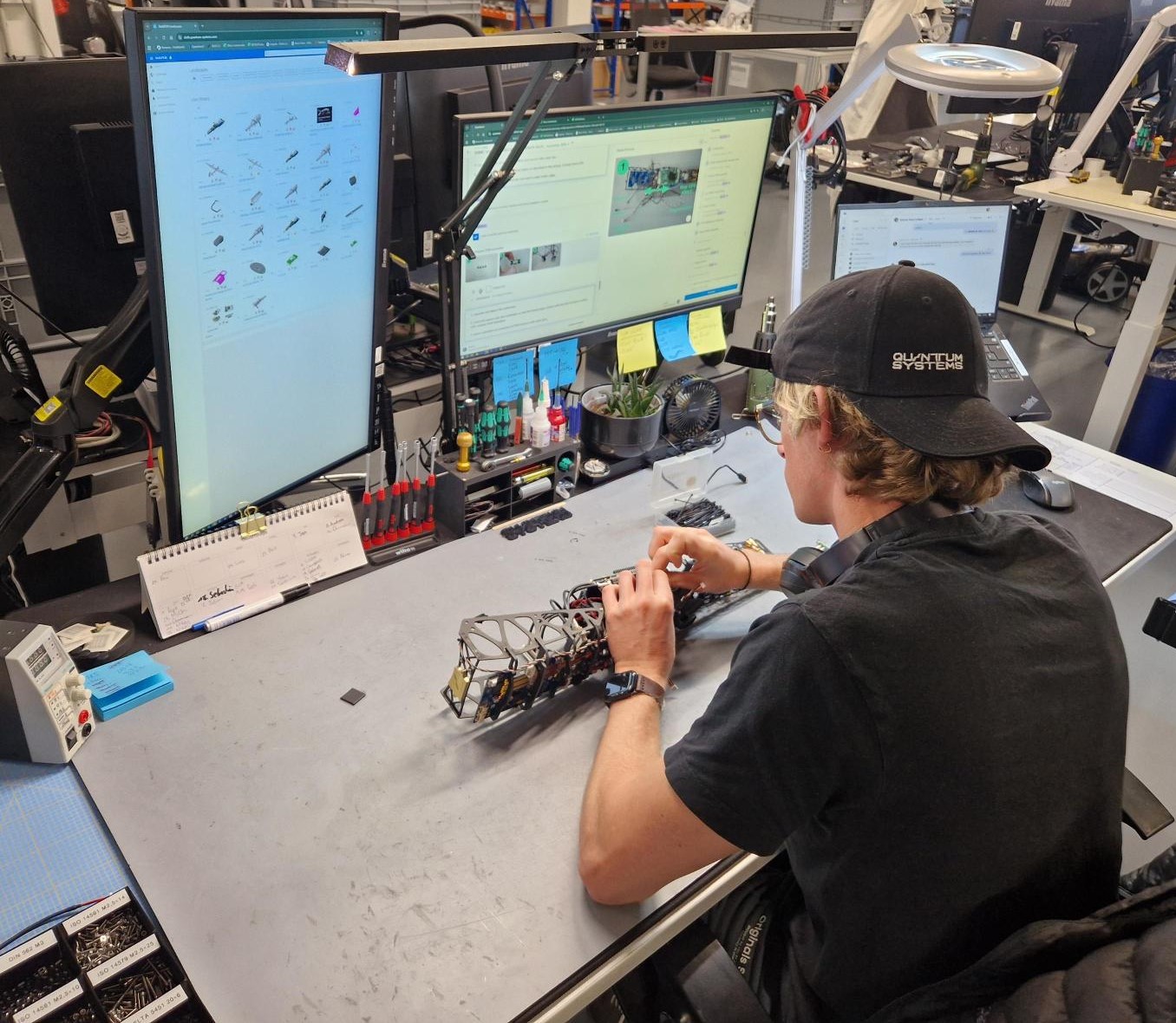
The knowledge of experienced employees was transferred into digital work instructions with images, videos and interactive elements. New and experienced employees alike now get clear step-by-step guidance that gives them confidence and simplifies their work. Digital inspection processes and defect tally sheets were added. Changes go straight into the instructions and are visible to everyone the next time a report is started, which makes change management on the shopfloor much easier.
Serial Numbers by Scan Instead of by Hand
The integrated serial number capture made a decisive difference. Instead of using a phone, a paper list and a scanner, employees capture the serial number, for example on the power distribution board, by scanning a QR code directly in the work step. This rules out transcription and typing errors, and the captured values are searchable. A batch, for example, can be found in a targeted way, which makes recalls possible if needed. This strengthens complete documentation and traceability across the assembly and test process.
Global Rollout with Templates
Using the built-in automatic translation, the instructions were translated into English, and into Czech for a supplier. Quantum Systems defines its best practices at headquarters and rolls them out as the standard to all sites. The plants can adapt the templates to local conditions, but the baseline stays the same everywhere.
"Every site is able to implement changes quickly. That saves a great deal of time and effort," says Andrea Schugmann.
The Results
+300% output within 12 months: Quantum Systems did not increase its output by tripling its workforce, but through standardized, simpler processes and by specializing employees in clearly structured work steps.
Error rate reduced from over 50% to under 2%: Previously, internal quality control sent more than half of the drones coming out of production back for rework. Mandatory interactions in the work instructions, revised instructions and additional self-inspections by production reduced this rework rate to under 2%.
Training time cut from 1.5 months to 2 weeks (−70%): With visually supported work instructions, new employees quickly work on their own. Support from experienced colleagues is only needed occasionally.
"Before Operations1, we had an error rate of more than 50%. Today we're below 2%. That speaks for itself," says Robert Niederhuber, Head of Production Gilching at Quantum Systems.
A simple calculation shows how closely output and error rate are linked: if the error rate had stayed at its old level while output increased, every second drone would have gone into rework and tied up exactly the experienced specialists needed for scaling. "We really managed to triple our output, and we didn't do it with three times as many employees. The processes were standardized, they became simpler. Otherwise it would never have been possible," says Andrea Schugmann.
What started as a pilot in assembly has become a platform for the entire value chain: from supplier integration, goods receipt, quality assurance and assembly to packaging and shipping. The main Czech supplier of fiberglass components is a good example. Where Quantum Systems once rated a part as B quality and the supplier rated the same part as A quality, jointly defined defect images in Operations1 now ensure a shared understanding of quality. New products also reach series production faster: for the Twister, production engineering was involved from the start, and instructions are now created in parallel with development.
Thanks to its multilingual capabilities, Operations1 is now used in more than five plants worldwide, securing international quality standards and making sites comparable. The US site and, most recently, Australia were able to start production directly with the existing standards, without lengthy training through a mentoring system. Knowledge flows in both directions: improvements from Australia also make their way back into processes at headquarters. "No matter where you buy the product, you get the same quality," says Andrea Schugmann.
Outlook
As its next major step, Quantum Systems plans to connect Operations1 to its ERP system. Serial numbers are already extracted from Operations1 via API, which has significantly shortened booking processes. In future, the integration should be in place from the start for new products. Other plans include introducing qualification management, digital onboarding plans, safety briefings and test equipment management, more automated variant management and, in the long term, a digital product history file that acts as a kind of digital twin for every drone.
About Quantum Systems
Quantum-Systems GmbH, headquartered in Gilching near Munich, develops and manufactures unmanned aircraft systems, including vertical take-off and landing (eVTOL) fixed-wing and tilt-rotor drones. Its portfolio includes the Trinity for commercial surveying and mapping, the Vector for government and security applications with a flight time of up to 180 minutes, and the compact Twister.
Founded in 2015, the company now employs more than 700 people and operates production sites in several countries, including Germany, the USA, Ukraine and Australia. Since 2025, Quantum Systems has been one of Germany's unicorns. Its production is defined by highly complex, compact products, a growing number of variants and the traceability requirements for flight-critical components under the aerospace standard EN 9100.