
POLIPOL manufactures upholstered furniture to individual customer specifications at nine plants in Eastern Europe, introduces more than 100 new models every year and trains more than 300 new employees annually. Until 2017, assembly ran on paper, and much of the process knowledge sat in the heads of experienced employees. With Operations1, POLIPOL has cut training time from 12 months to 3 and saves more than €2.2 million a year as a result.
Key Takeaways
POLIPOL, furniture industry (high-quality upholstered furniture made to customer specifications)
Knowledge management and training in assembly with variant-specific, order-specific work instructions and ERP integration
More than €2.2 million saved per year, mainly through more efficient training of new employees
Training time for new employees cut from 12 months to 3
More than 2,000 employees at nine production sites work with Operations1
The Starting Point
Individuality is at the heart of POLIPOL's quality promise, true to its slogan "People & Furniture." There are no machine-made mass products here: every piece is made to customer specifications. What had long driven growth became a challenge as demand rose: the huge number of variants made training new employees increasingly difficult.
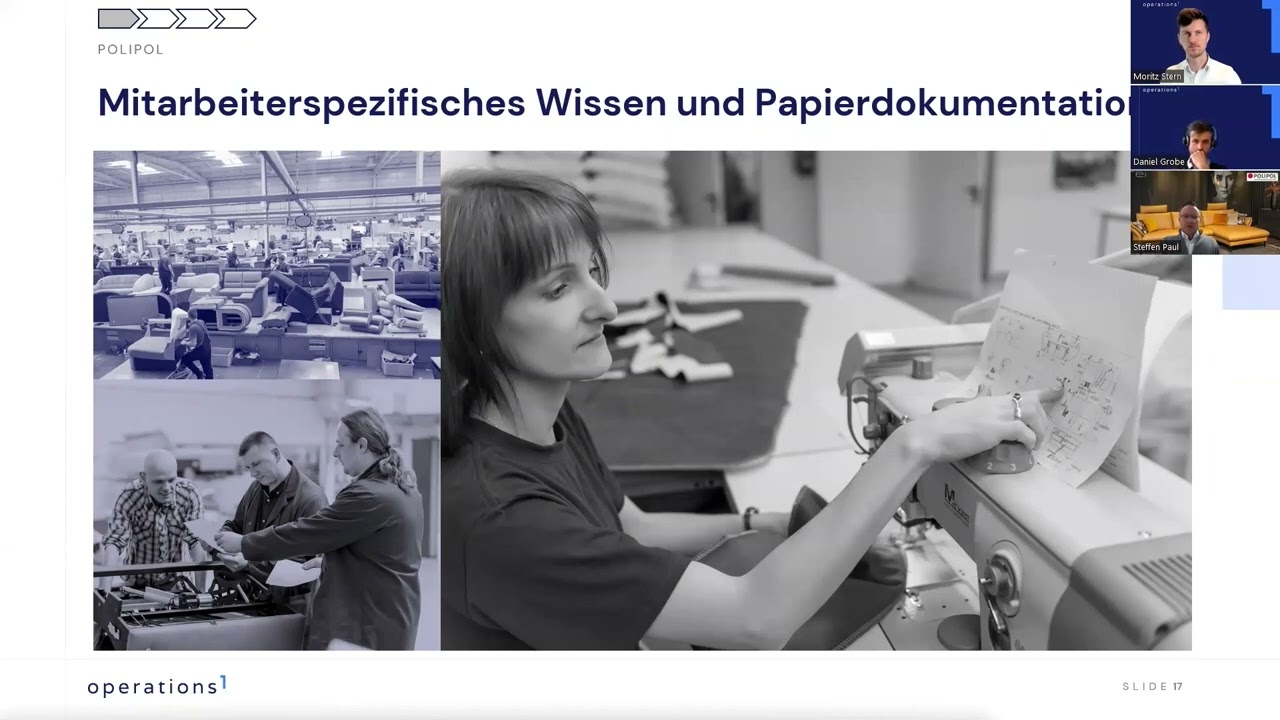
Until 2017, assembly instructions were created in Word, Excel or PowerPoint and provided on paper. This documentation was not ergonomic, processes were not transparent, and a lot of additional knowledge existed only in the heads of individual employees. Everyone interpreted how to carry out a process a little differently. An ERP system was in place, but on the shopfloor it did not provide the information each employee needed to do their job.
At the same time, the company was growing fast. To stay on course, POLIPOL had to scale its processes and keep hiring new employees who could become productive quickly. With more than 300 new employees in training every year and more than 100 new models annually, one thing was clear: static paper processes that were costly to change put quality and productivity at risk.
This situation is typical of high-variant manufacturing with a large share of manual work, whether in the furniture industry or in machine building. Anyone who has to manage many variants, many new employees and several sites at the same time quickly reaches the limits of paper and tacit knowledge.
The Path to the Solution
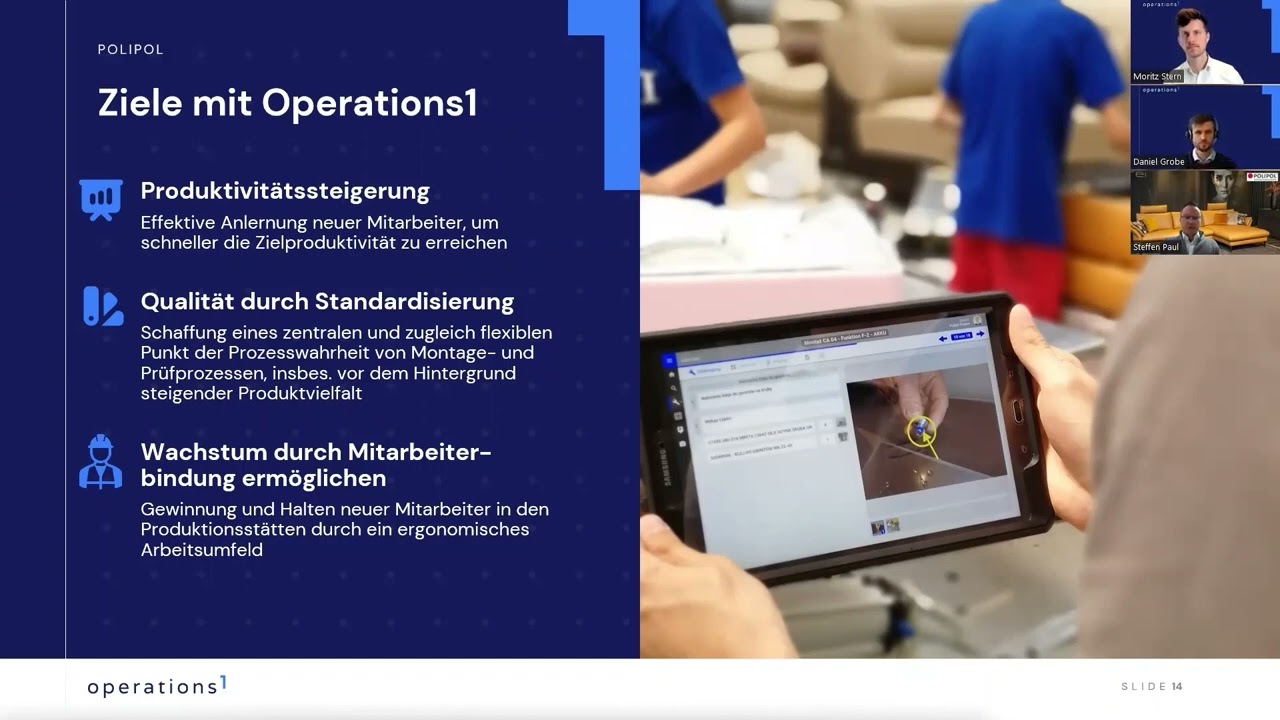
POLIPOL pursued three goals with Operations1: higher productivity through effective training that helps new employees reach target productivity faster, assured quality through a central yet flexible standard for assembly and inspection processes, and growth through stronger employee retention thanks to a modern, ergonomic working environment. This was implemented in three stages.
Stage 1: Digital Work Instructions Instead of Paper
The first step was to relieve employees of non-value-adding, paper-based tasks. Assembly and inspection processes were transferred into media-rich digital work instructions. The visual presentation guides employees step by step through the process and makes training much more efficient. At the same time, process reliability and therefore quality increased, so less rework is needed.
Stage 2: Standardizing and Reorganizing Knowledge
With nine sites, managing, versioning and archiving printed work instructions was becoming more and more complex. To prevent version chaos before it could start, POLIPOL defined its processes centrally in Operations1. The product and organizational structure for more than 4,800 documents was mapped using tags and structure classes. Since then, changes can be made centrally and released to all employees at all sites with a single click. This also simplifies the ramp-up of new products.
"Operations1 creates significant added value for POLIPOL. We need much less time to make information available at our production sites," says Kevin Minkler from the design department at POLIPOL.
Stage 3: ERP Integration and Automation
Because POLIPOL wanted to take digitalization end to end, the final step was integration with the ERP system. Orders are now transferred automatically, and the right variant-specific assembly and inspection instructions are generated automatically for every customer-specific order. The right operator accesses them at the right time on a tablet or stationary terminal, at every site and without media breaks or extra paper manuals.
The Results
More than €2.2 million saved per year: The direct savings come mainly from more efficient training of new employees.
Training time cut from 12 months to 3: With more than 300 new employees a year, this is a major lever. New colleagues reach their target productivity much faster.
More than 2,000 employees work with Operations1: The platform is used at all nine production sites.
Less rework, higher productivity: Order-specific documentation ensures that every operator receives exactly the instructions for the variant they are currently building.
"Operations1 is a central building block of POLIPOL's digitalization strategy. The cloud-based software platform has enabled us to digitally integrate the last mile to our employees," says Steffen Paul, Head of Industrial Engineering at POLIPOL.
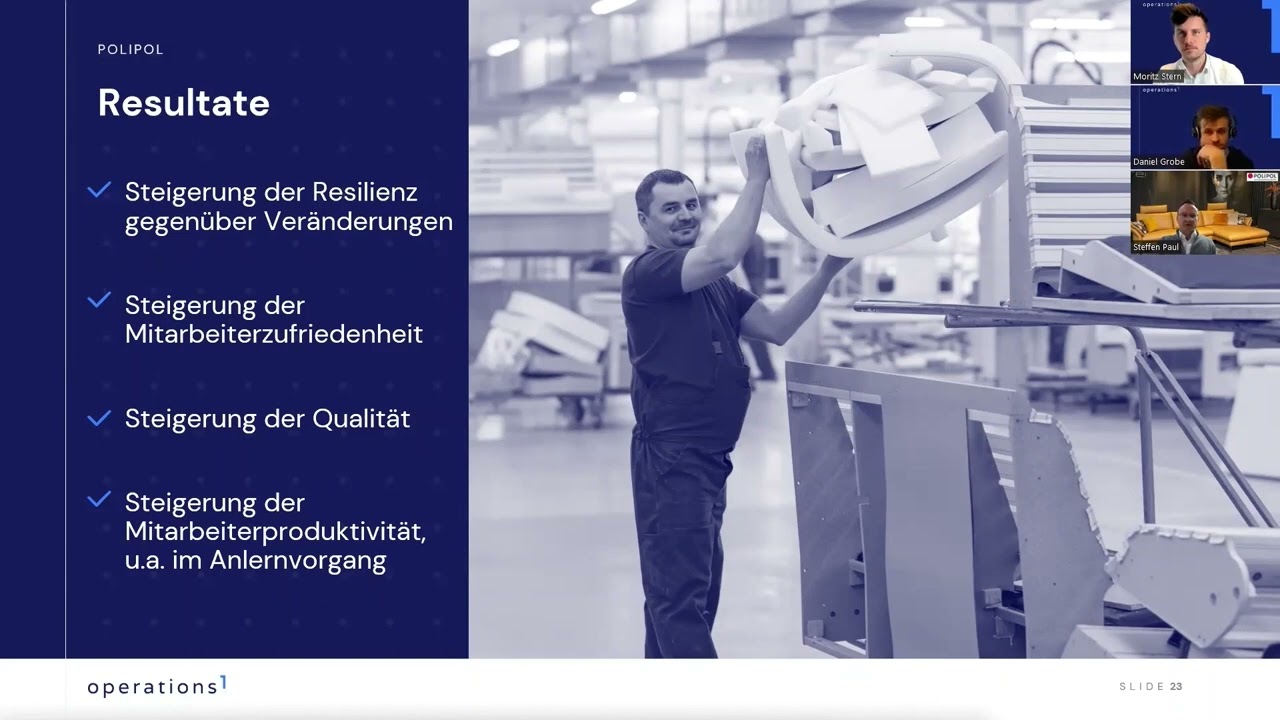
Non-value-adding work around paper documentation has disappeared. The ergonomic working environment and the platform's ease of use have increased employee satisfaction, which strengthens long-term retention. Knowledge is scaled, and processes are connected across all sites, making production more resilient and future-proof.
Another effect will pay off over the long term: by bringing operational employees into a connected organization, POLIPOL is building extensive data pools from which it can derive quality-relevant insights for continuous improvement across the company.
About POLIPOL
POLIPOL is a manufacturer of high-quality upholstered furniture headquartered in Diepenau, Lower Saxony, Germany. With craftsmanship and attention to detail, the company makes individual pieces of furniture to customer specifications. They are developed in Germany and produced at nine plants in Eastern Europe. With its subsidiaries and more than 7,500 employees in Germany and abroad, the POLIPOL Group is one of Europe's leading upholstered furniture manufacturers.
Its production is defined by a high share of manual work, a very large number of variants with more than 100 new models a year, and a continuously high demand for new employees.