
The Oetiker Group manufactures connecting solutions for mobility and industrial applications at 13 production sites worldwide, where hundreds of machines have to be maintained in cycles ranging from daily to yearly. Despite an established lean culture and a new MES, maintenance was still planned using Excel, Outlook and magnetic boards, and carried out on paper. Since Oetiker began digitalizing preventive maintenance with Operations1 in 2021, OEE at its Canada site has risen by 11 percentage points within six months, with 5 percentage points more equipment availability and 23% shorter repair times.
Key Takeaways
Oetiker Group, industrial goods (high-end connecting solutions such as clamps, rings, straps and quick connectors)
Digital preventive maintenance integrated with the MES Leading2Lean
+11 percentage points OEE at the Canada site, 6 months after introducing Operations1
+5 percentage points equipment availability
−23% Mean-Time-To-Repair (MTTR)
The Starting Point
Oetiker is no newcomer to digitalization. The company established a global lean manufacturing culture early on and used methods such as visual management, 5S and Total Productive Maintenance at all its plants. In 2020, it introduced the global MES Leading2Lean (L2L). For the first time, Oetiker knew systematically how long machines run, when and why they stop, and when maintenance cycles are due.
The gap lay in between. L2L provided the maintenance intervals, but the detailed planning of maintenance work was still done manually using Excel, Outlook and magnetic boards. Maintenance instructions reached the machine on paper, the documentation was then archived digitally and the order closed in L2L. The result was media and system breaks, a lack of transparency and time-consuming reporting.
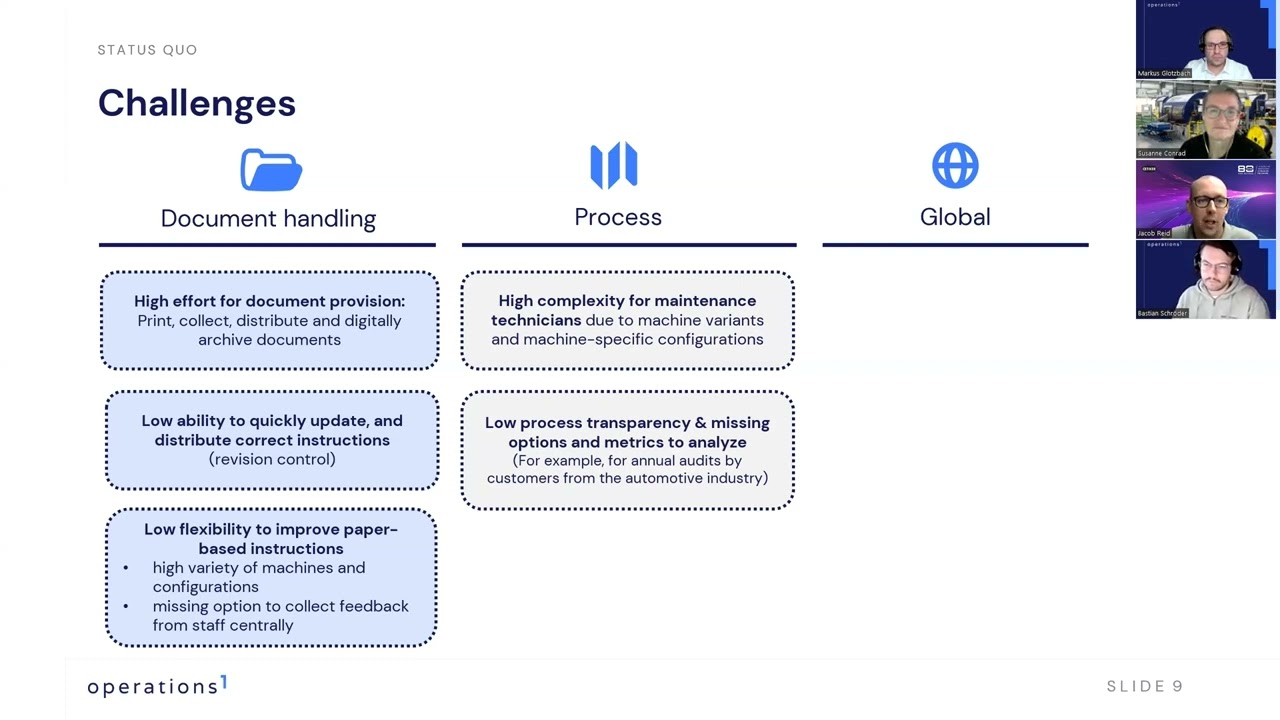
The problems showed up on three levels:
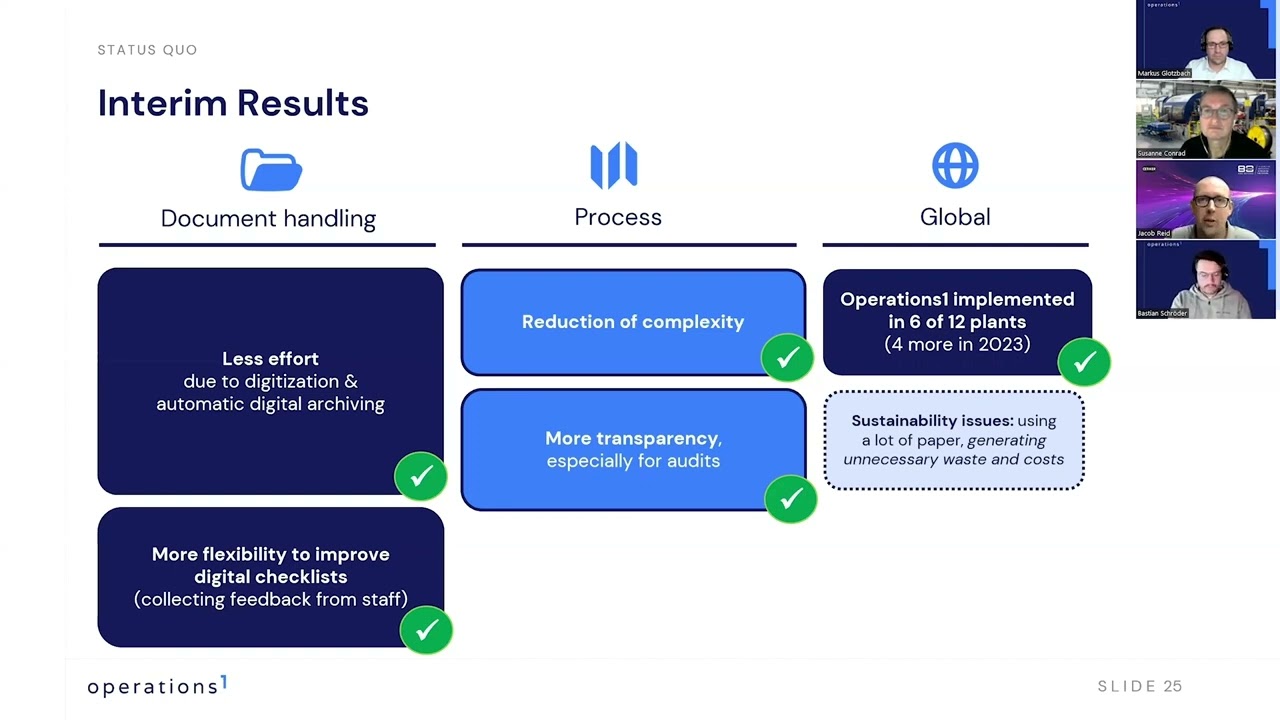
Document handling: Creating, approving, revising, distributing and filing maintenance instructions was extremely time-consuming. Hundreds of machines with different maintenance cycles and machine-specific differences at each site could not be reliably managed with manual processes. The risk of errors was always present.
Process level: There was no Single Point of Truth for document management, maintenance planning and documentation. There was a risk of version chaos, and because the paper documentation had gaps, maintenance processes were hard to analyze.
Global perspective: Across all national and international plants, these factors slowed down the standardization of maintenance practice.
Oetiker is a typical example of many industrial companies with machine-intensive production: the data from the MES is there, but the last mile to the maintenance technician at the machine is still analog. That is exactly where time losses, errors and blind spots arise.
The Path to the Solution
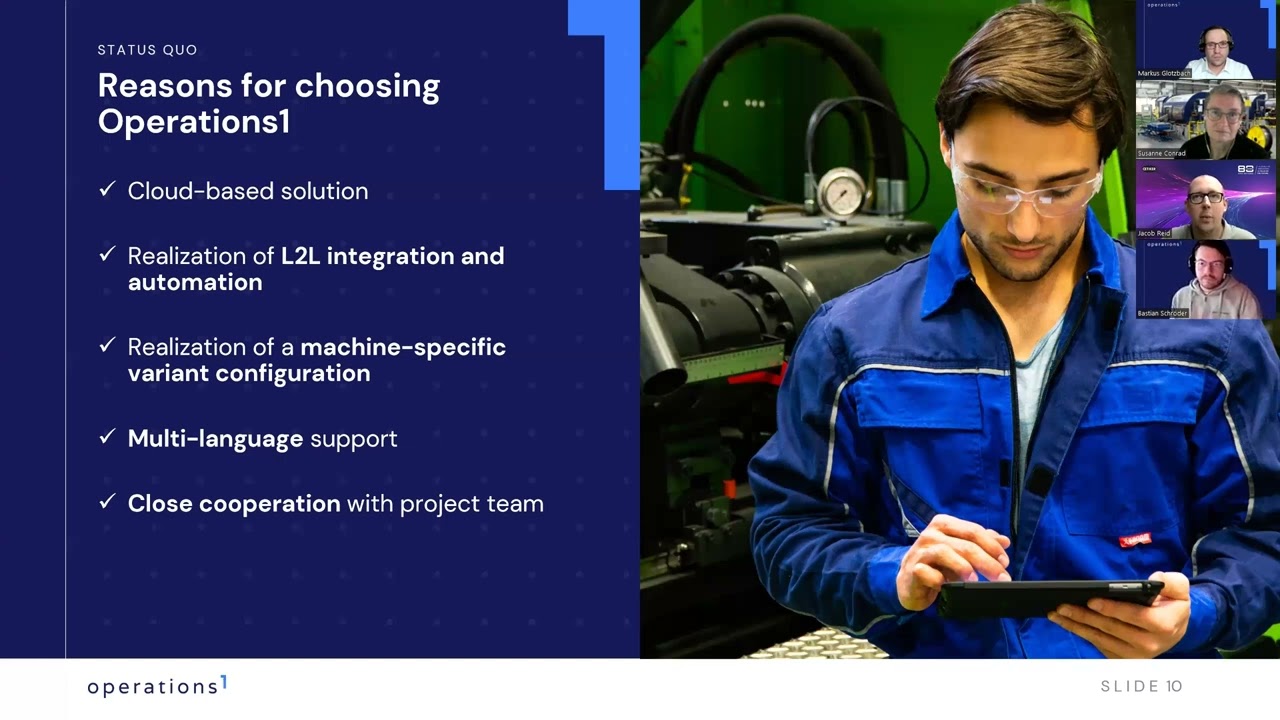
When Oetiker started the global implementation of Operations1 in 2021, the goal was clear: to fully digitalize its existing lean-based maintenance system. The company was looking for a solution that could be used globally and would be available to every employee at any time. Operations1 proved to be the right sparring partner. The deciding factors were the cloud-based platform, seamless integration with Leading2Lean including automation, the ability to map machine-specific variants, and multilingual capabilities. Fast implementation and high usability were also key.
Connecting the MES and the Shopfloor
By integrating with L2L, Operations1 closes the gap between maintenance planning and execution. The right employee receives the maintenance instructions relevant to them at the right time, without manual planning in Excel or on magnetic boards.
Machine-Specific Checklists Instead of Paper
Maintenance technicians work through the maintenance instructions step by step on a tablet touchscreen, as intuitive digital checklists and inspection records. Detailed machine-specific instructions are built in. Oetiker uses structure classes to map the different machine types in the backend, and the modular structure of the documents makes the solution scalable across many machines and sites.
A Single Point of Truth for All Plants
All the documents that used to sit in piles of paper are now bundled in one place, always up to date and accessible from any site. Real-time process data and automatically generated reports create the transparency that was missing before. To date, Oetiker has rolled out Operations1 at 6 of its 13 production sites, replacing paper-based maintenance work there with digital processes.
"With Operations1, we are establishing a global standard for preventive maintenance in our 13 plants," says Susanne Conrad, Head Equipment Engineering at the Oetiker Group.
The Results
Oetiker has set itself an ambitious goal: to reach an OEE of 85% in the long term. The Canada site reached the first milestone quickly:
+11 percentage points OEE in 6 months: Six months after Operations1 was introduced, overall equipment effectiveness at the Canada site rose by 11 percentage points.
+5 percentage points equipment availability: Better planning and regular maintenance prevent machine breakdowns.
−23% Mean-Time-To-Repair: The average repair time after a machine breakdown fell by almost a quarter.
"With a digitalized approach to maintenance, we were able to increase overall equipment effectiveness by 11 percentage points after just 6 months," says Jacob Reid, Head Engineering at the Oetiker Group.
A lot has changed in day-to-day maintenance. Better planning and regular maintenance help avoid machine breakdowns as well as high repair and spare parts costs. Non-value-adding documentation work is eliminated, and maintenance has become more efficient in both planning and execution. An important side effect: the digital process enables autonomous preventive maintenance. Operators can take on smaller maintenance tasks themselves, which makes staff deployment more flexible. Well-maintained machines also create a safe and modern working environment.
Digitalization also pays off in audits. All maintenance activities are fully traceable, and complete documentation with automatically generated reports ensures audit readiness for customer audits.
Outlook
After 6 of its 13 plants, Oetiker is already planning to roll out Operations1 at 4 more sites. The goal remains a consistent global standard for preventive maintenance and an OEE of 85%.

About Oetiker
The Oetiker Group is a leading global provider of high-end connecting solutions, headquartered in Switzerland. The company manufactures high-quality clamps, rings, straps and quick connectors for a wide range of mobility and industrial applications, serving customers in the automotive, retail and industrial sectors. Oetiker takes a 360-degree approach that integrates connecting, assembly and global engineering services.
The Oetiker Group has 13 production sites worldwide and employs more than 2,000 people. Its production is defined by a large machine park with hundreds of machines, different maintenance cycles and machine-specific differences between sites.