
KraussMaffei configures its injection molding, extrusion and reaction process systems largely to customer requirements, and every one of these variants has to pass an extensive factory acceptance test before delivery. Until 2021, this process ran on paper: printed master checklists, items crossed out by hand and up to 350 pages of test records per machine, which then had to be scanned. Today, commissioning engineers work with digital, order-specific checklists, documentation effort in Hanover has fallen by 67%, and the company saves 1,200 working hours a year.
Key Takeaways
KraussMaffei, machinery and plant engineering (machines and systems for plastics and rubber processing)
Digital commissioning (Factory Acceptance Test) and quality inspection with ERP integration
1,200 working hours saved per year through digital commissioning
67% less documentation effort at the Hanover site, where processing time has dropped from three days to one
60 minutes less processing time per machine at the Munich plant
The Starting Point
Anyone who configures machines to individual customer requirements knows the dilemma: variety is a competitive advantage, but it makes every downstream process more complex. At KraussMaffei, this was especially clear in commissioning. To ensure the highest quality, the company thoroughly tests every machine for full functionality in the Factory Acceptance Test (FAT).
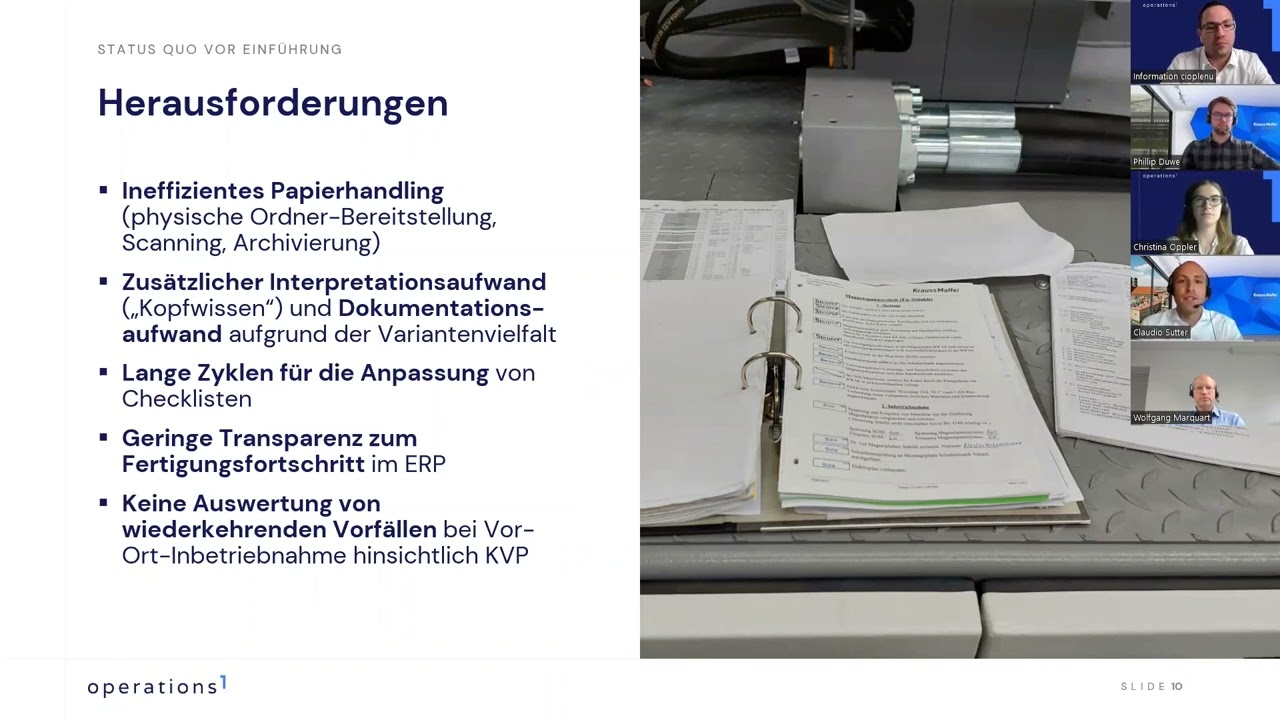
The process behind it was full of media breaks. Quality assurance created bilingual test records in Word or Excel, known as master checklists, printed them out and provided them physically in a comprehensive order folder. Commissioning engineers worked through these lists meticulously, crossed out irrelevant items by hand and added notes manually. Once finished, everything was scanned and filed in SAP, with extensive records running to up to 350 pages per machine. When a question came up later, the search through the physical document began.
The consequences went beyond the time involved. The large number of variants created extra effort for interpretation and documentation, updating the checklists took long cycles, production progress was hardly visible, and there was no basis for continuous improvement. Above all, highly qualified commissioning engineers spent a lot of time on paperwork instead of their actual value-adding work on the machine.
The Path to the Solution
A cross-site team led by Claudio Sutter, Wolfgang Marquart, Phillip Duwe and Holger Labusga set out to find the right software. From the start, the goal was bigger than a single use case: beginning with commissioning, the digitalization of employee-driven processes was to be rolled out as a bottom-up project across all sites and production processes, from assembly, quality inspection and service to production-related processes such as 5S audits.
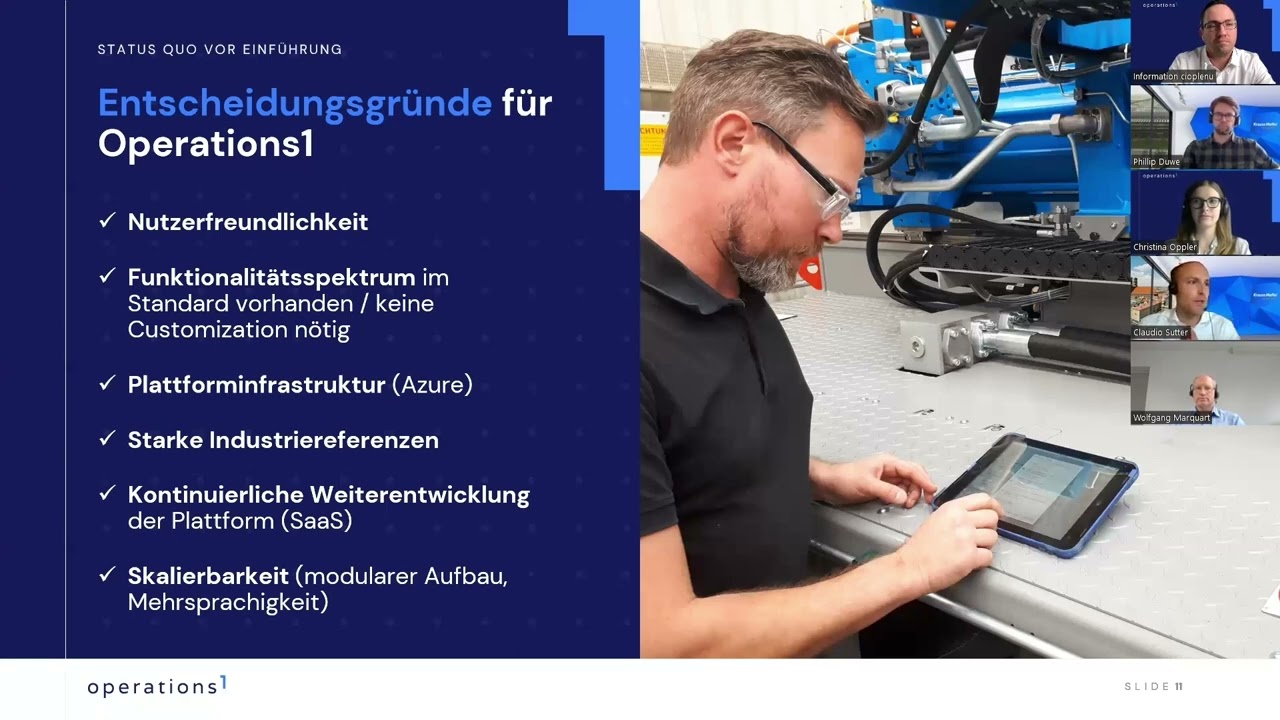
After thorough market research, internal testing and a comprehensive cost-benefit analysis, KraussMaffei chose Operations1. The deciding factors were its high usability, broad range of functions, platform infrastructure and scalability, including its modular structure and multilingual capabilities. Strong industry references and the continuous development of the software as SaaS also played a role.
"We spent a long time researching to bring the right partner on board. With Operations1, we can map our processes end to end along the entire value chain," says a manager at KraussMaffei.
The First Step: Munich and Hanover
The project started with commissioning at the Munich site and quality inspection at the Hanover site. Commissioning was seen as the biggest lever and therefore the logical starting point for the wider rollout. The joint project team from KraussMaffei and Operations1 also worked together on site in Munich.
ERP Integration Instead of Order Folders
Right after the initial rollout, Operations1 was connected to the ERP system. Since then, orders from the ERP are automatically linked to the matching commissioning records in Operations1, and completed records are filed seamlessly in the DMS. All the documents that used to sit in piles of paper are now bundled in a single order. Commissioning engineers see exactly the inspection order that is relevant to them instead of having to interpret a master checklist.
The New Process at the Machine
Commissioning engineers work on the go with a laptop, tablet or smartphone and are guided step by step through the inspection with images, PDFs and videos. Using the chat function, they can ask questions and assign tasks directly from the process. Once commissioning is complete, Operations1 automatically generates a report that can be exported as a PDF or Excel file. Scanning is no longer needed.
The Results
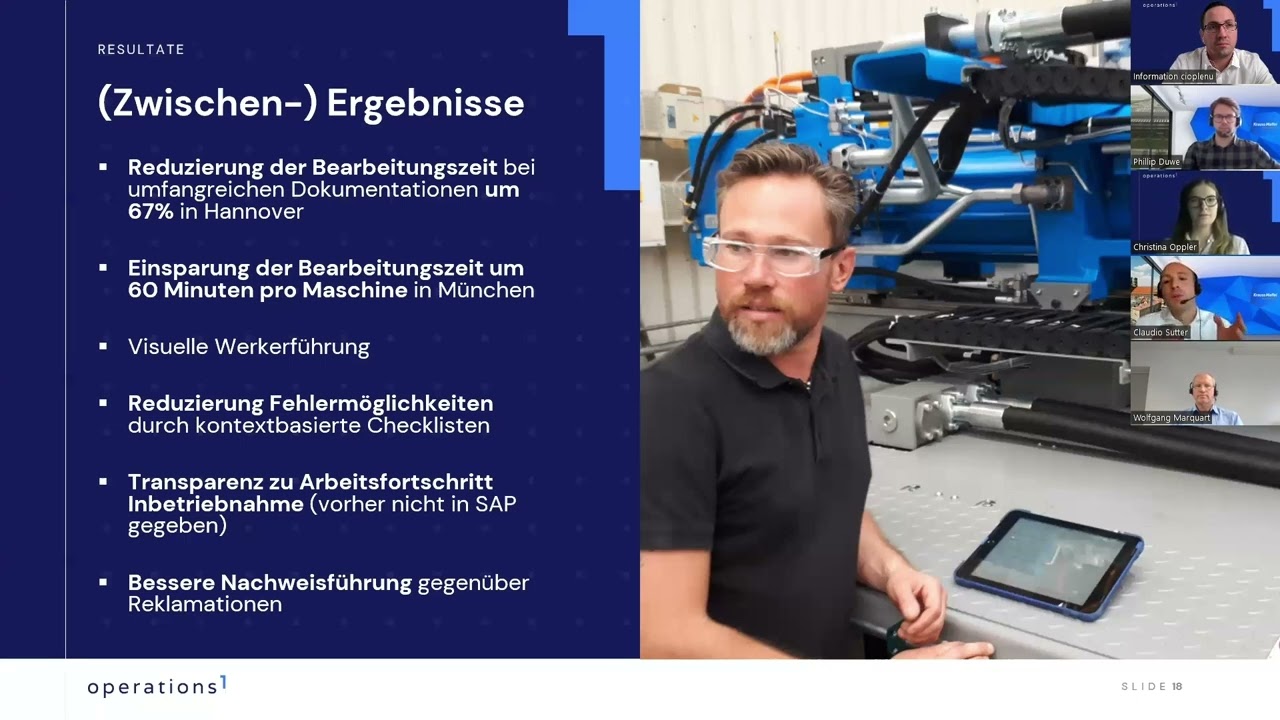
1,200 working hours saved per year: Digital commissioning reduces KraussMaffei's overall effort by 1,200 working hours annually.
67% less documentation effort in Hanover: At the Hanover site, this cuts processing time from three days to one.
60 minutes less processing time per machine: KraussMaffei saves this time on every machine at its Munich plant.
No more scanned piles of paper: The up to 350 pages of paper per machine that used to be scanned and archived are gone entirely.
"Thanks to Operations1, we save 67% of our documentation effort. This reduces processing time at our Hanover site from 3 days to 1 day," says a manager at KraussMaffei.
The relief works on two sides: commissioning engineers at the machine are guided through the inspection step by step, and quality assurance no longer has to print, compile and archive checklists. Context-based checklists reduce the potential for errors, visual worker guidance makes the process easy to follow, and work progress is visible at all times.
Something has also changed for customers. The complete documentation in the automatically generated reports strengthens their confidence that commissioning was carried out carefully and thoroughly. Questions can be answered quickly, and KraussMaffei is better protected against potential complaints. Finally, digital documentation provides the basis for systematically identifying and fixing errors and preventing them in the future.
Outlook
KraussMaffei plans to continue on this path and use Operations1 as a platform for connected work across the entire value chain, at the international sites in Jiaxing and Sucany as well as in Hanover. Next up is the digitalization of service processes, followed by pre-assembly and final assembly.

About KraussMaffei
KraussMaffei is one of the world's leading manufacturers of machines and systems for producing and processing plastics and rubber. Its portfolio covers injection molding, extrusion and reaction process technology as well as additive manufacturing. Its customers include companies from the automotive, packaging, medical and construction industries as well as manufacturers of electrical and electronic products and household appliances.
Founded in 1838, the company is headquartered in Munich and employs around 4,700 people worldwide in a network of 30 subsidiaries. Its production is defined by a high number of variants, as machines and systems are configured to individual customer requirements, which in turn requires a complex commissioning process.